Closing the Purpose Gap

In a world reshaped by pandemic and purpose, the game has changed. Money isn't everything; values and impact matter. It is no coincidence that fans have started realising about more important things than just winning trophies, or signing big players. With a cry for social justice and improved sustainability practices, teams are expected to show a strong commitment to a cause higher than profit and revenues.
Clubs recognise this shift in global values and understand the need for a well-defined purpose. However, they struggle with its intangible nature and often fail to effectively communicate this to their players and fans. Without a tangible growth trajectory or an impact score, it becomes challenging for sports businesses to validate their purpose-driven strategies.
This sometimes leads to reliance on traditional KPIs to keep the stakeholders happy, which might reap rewards in the immediate future but often proves fatal in the long term. Companies are accused of purpose-washing or sports-washing, making it impossible to build loyalty and brand affinity with their consumers.
This results in what academics call a 'purpose gap'. It arises from the disparity between a company's purpose statement and its actions. While most see this as a threat, it brings a huge opportunity for businesses to identify, evaluate, and rectify their existing process and communications to move closer to their purpose.
Types of Purpose Gaps
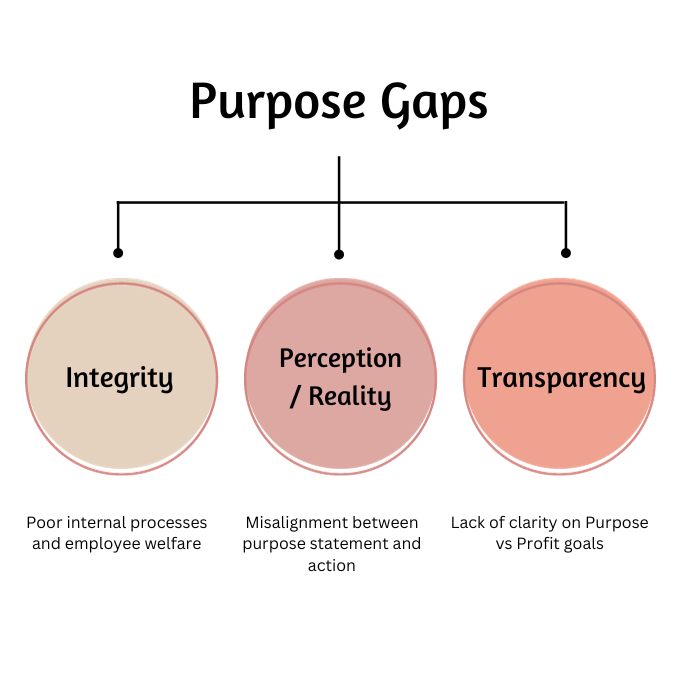
Research conducted by Deloitte identified a few broad types of gaps that negatively affect an organisation's purpose-driven future. Let's have a look at them in the context of the sports industry
Perception/Reality Gap
The survey revealed a misalignment in the external communications by a company and its internal practices. For a sports fan riding high on passion, it does not take much from their club to paint a misleading 'purposeful' image. The world of social media and strategic marketing enables these organisations to build a false image among their fans.
This lasts only until the bubble bursts.
The infamous European Super League was one such instance, where the gap between the clubs' so-called fan-first values was exposed. Supporters quickly realised the hypocrisy of their clubs and revolted against their own, forcing the clubs to back out of this commercially-driven plan.
Integrity Gap
In a bid to please fans and customers, sports organisations sometimes forget about one of the key stakeholders - their employees.
A company's workforce is the fuel that keeps the engine running. With all the focus on the athletes, customers, and owners, the employees can sometimes feel sidelined. Research suggests that employees believe the first step to acting on a purpose-driven path is to treat them respectfully and fairly.
Sports Direct, a sports retail company founded by former Newcastle United FC owner Mike Ashley, came under fire for its employee policies and work conditions. While the company's purpose statement boasts of using the power of sports for good, it seems to have failed to create a positive impact internally. Things have been changing for the better but it could take a while to repair the damage already done.
Transparency Gap
Deloitte's survey shows that stakeholders don't mind hearing Purpose and Profit in the same breath. What they don't receive well is the lack of transparency.
It is important for clubs and sports businesses to clearly communicate their purpose strategy and back it up with a transparent display of impact reports. Using the power of data to track and present metrics like Social Return on Investment or articulating their why with strong frameworks could help build trust and reduce this gap.
A brilliant example of authentic and clear purpose-driven communications is Forest Green Rovers FC (FGR). Described as the 'greenest football club in the world', FGR publishes every aspect of their strategy in the public domain. From tracking campaign impact to showcasing their activations, the club are trying to build trust among their fans.
How to Close the Purpose Gap?
Bridging the gap between a club's desire to affect positive change and its actions requires an intentional approach. It mandates an organisation-wide effort to clearly define and communicate the core values both internally and externally.
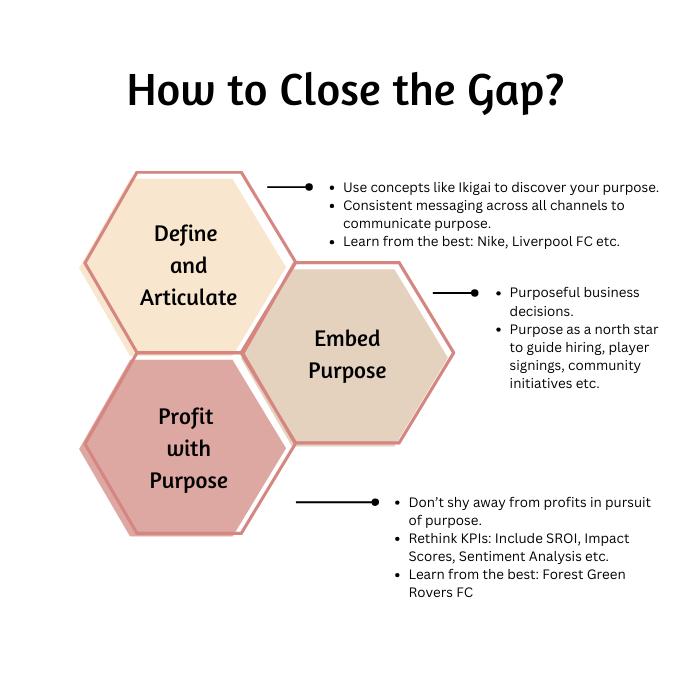
Here are some key strategies that could help lead a purpose-led movement
Define and Articulate
Without a clear definition of values, goals, and purpose, it becomes challenging for the stakeholders to connect to the brand.
Using concepts like Ikigai, sports businesses could discover their authentic values and explore the 'Why' of their existence. The key is staying true to the core ideas and beliefs while defining the purpose. Including your employees or fans in this process might be a good idea to co-create the purpose statement.
Once you have your well-defined purpose ready, ensure it is clearly communicated internally and externally. Use your internal company meetings and social media channels to share your vision and plans. Remember to keep your communications consistent and authentic to foster trust and loyalty.
Look at how other purpose-driven organisations like Nike, FC Barcelona, and Liverpool FC among many articulate their purpose in a way that resonates with their fans across the globe.
Embed Purpose in all Aspects
Once you have articulated your well-defined purpose, it is crucial to infuse it into every area of the business. To achieve this, use the purpose as a guiding force in your decision-making, business strategy and behaviour. It is important for everyone in your ecosystem to align with the higher goal in order to drive a transformational change.
A major factor in creating a purpose-driven culture is the attitude of the employees. As a sports club, make sure everyone from your backroom staff to your players and coaches aligns with your values and beliefs.
A great example of this is Liverpool FC and how their players and managers are a perfect fit for the culture. It is not a coincidence that Jurgen Klopp and his team bleed the values of passion, work ethic, and commitment while staying true to the club's motto of "You'll Never Walk Alone".
Adopt a 'Profit with Purpose' Mindset
In an ideal world, having a purpose alone should guarantee financial success from the get-go. But it is a long-term commitment. For a business to continue making an impact in the community, its financial performance has to be maintained along with the core values. Research shows the profitability of purpose-driven businesses in the long run outperforms their counterparts.
Therefore, tracking both the social impact (SROI, brand sentiment, fan feedback etc.) and the commercial KPIs (ROI, Revenue, Profit etc.) is extremely important to produce long-term impact.
Forest Green Rovers are a perfect case study for this approach. They are wholly driven by their purpose but also appreciate the importance of financial success.
The club are one of the rare few League Two clubs who publish their full financial accounts in the public domain. With their purpose of sustainability at the core, their business decisions and partnerships generated a £5m revenue in 2018 - way higher than the average in the league.
This should be an inspiration to any small-medium sports clubs/organisations to put purpose ahead of profit to achieve commercial success.
As we navigate this evolving landscape, bridging the purpose gap isn't a hurdle; it's a path to authentic engagement. Define it, embrace it, and watch a genuine connection drive enduring success.
Comments ()